
I’ve been building WordPress websites and running SEO campaigns for medical-based businesses in New York City for years. I’ve seen what works and what doesn’t.
Here’s what I know about medical practices in 2026: if you’re not showing up when someone searches for a doctor, you don’t exist to that patient.
This isn’t speculation. The data tells a clear story.
 The Search Behavior That’s Reshaping Patient Acquisition
 The Search Behavior That’s Reshaping Patient Acquisition
82% of patients research providers online before booking an appointment. That’s not a trend—that’s the baseline behavior now.
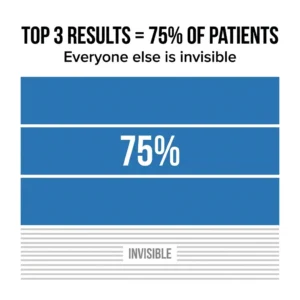
More revealing: 77% of patients begin their healthcare search on Google, and the top three results capture 75% of all clicks.
If your practice isn’t in those top three positions, you’re invisible when people make their choice.
I’ve watched this play out with the medical practices I work with. The ones ranking on page two of Google might as well not have a website. Page two doesn’t exist in the patient’s mind.
The average patient visits 5.4 websites during their research. They read reviews (71% do this), compare multiple providers (68%), and nearly half will switch providers after a poor online experience.
This isn’t casual browsing. Patients are conducting serious research, and your SEO presence needs to meet them at every touchpoint.
AI Search Is Changing The Game Faster Than Most Practices Realize
Here’s something that surprised me when I started tracking it: AI-powered search results now appear for 30-47% of queries in the U.S.
Healthcare searches trigger these AI Overviews at even higher rates.
By mid-2025, 26% of patients reported that AI tools—including AI-generated review summaries and conversational assistants like ChatGPT—had directly influenced their choice of healthcare provider. That puts AI on par with primary care referrals.
Medical practices that don’t optimize for AI visibility are missing nearly half of potential patient touchpoints.
The shift is measurable: 80% of consumers rely on AI-generated results for at least 40% of their searches. This has contributed to a 15-25% decline in traditional website traffic.
I’m adjusting my SEO strategies to account for this. It’s not enough to rank well in traditional search results anymore. You need to optimize for how AI interprets and presents your information.
That means structured data, clear expertise signals, and content that directly answers patient questions.
Local SEO Isn’t Optional—It’s The Primary Patient Acquisition Channel
“Doctor near me” searches have grown 185% since 2020.
70% of patients use Google My Business to find healthcare providers. Your Google Business Profile is your digital storefront—neglecting it means turning away seven out of ten potential patients.
I see this constantly in New York City. Patients aren’t just searching for “cardiologist” anymore. They’re searching for “cardiologist near me” or “cardiologist in Queens.”
54% of all healthcare website traffic comes from organic search. Practices with blogs get 4.8x more inquiries.
Organic search isn’t just a marketing channel. It’s the dominant patient acquisition engine for medical practices in 2026.
Younger demographics have fundamentally shifted from traditional referral networks to digital-first discovery. Patients under 45 are 3.2x more likely to choose a provider based on online presence than personal referrals.
The referral model that worked for decades is being replaced by search-driven discovery.
What Local SEO Actually Looks Like For Medical Practices
When I optimize a medical practice website, I focus on these elements:
- Google Business Profile optimization: Complete information, regular updates, photo uploads, and active response to reviews
- Local content creation: Pages targeting specific neighborhoods and conditions
- Schema markup: Technical code that helps search engines understand your practice details
- Citation consistency: Your practice information appears identically across all directories
- Location-specific service pages: Dedicated pages for each service you offer in each location
Schema markup alone increases click-through rates by 156% in search results. Proper technical implementation can more than double the effectiveness of your search rankings.
Content Quality Now Directly Determines Rankings
Google’s E-E-A-T requirements (Experience, Expertise, Authoritativeness, Trustworthiness) have become stricter for medical content.
Physician-authored content ranks 3.2x higher than generic marketing copy.
In 2026, content quality isn’t just about keywords—it’s about demonstrable medical expertise.
I work with practices to create content that shows real expertise. That means:
- Articles written or reviewed by actual physicians
- Clear author bios with credentials
- Citations to medical research when appropriate
- Content that answers specific patient questions
- Regular updates to keep information current
Websites that demonstrate high E-E-A-T see 40-50% higher organic visibility in medical search results. This represents a massive competitive advantage for practices that invest in expert-authored, credible content.
Generic blog posts written by marketing agencies don’t cut it anymore. Google can identify medical expertise, and it rewards content that demonstrates it.
The Review Economy Is Now The Reputation Economy
Here’s a number that should concern every medical practice: a single 1-star review can cost a practice 30 patients per year.
Negative reviews drive away 84% of potential patients.
72% of patients check online reviews before booking an appointment. Reviews have become the digital equivalent of word-of-mouth referrals, but with exponentially greater reach.
Around 90% of patients read online reviews before choosing a healthcare provider.
I help practices develop review generation systems that work. This isn’t about gaming the system or buying fake reviews. It’s about creating a consistent process to ask satisfied patients for feedback.
The practices that do this well have review profiles that reflect their actual quality of care. The ones that ignore reviews end up with a handful of negative reviews from unhappy patients—and nothing to balance them out.
61% of patients say they trust online reviews more than personal recommendations from friends or family. Your online reputation is your reputation.
Mobile Experience Determines Whether You Capture Or Lose Patients
63% of medical searches happen on mobile devices.
Mobile searchers behave differently than desktop users. They want information fast. They expect pages to load quickly. They abandon slow sites immediately.
I build WordPress websites that load fast on mobile devices. This isn’t just about user experience—it’s about conversion.
Mobile devices account for 65-75% of all initial telehealth service discovery searches.
For practices offering virtual care, mobile optimization isn’t optional. It’s mission-critical.
When I audit medical practice websites, I find the same problems repeatedly:
- Slow loading times on mobile
- Text that’s too small to read
- Buttons too close together to tap accurately
- Forms that are difficult to complete on a phone
- Click-to-call buttons that don’t work
These aren’t minor issues. Each one costs you patients.
The Investment Case For SEO Is Stronger Than Ever
The healthcare digital marketing market is $6.4 billion in 2026, growing 18% annually.
Organizations investing in digital see a 4.8x ROI, primarily through patient acquisition.
90% of medical companies plan to increase or maintain their digital marketing investment in 2026. Practices that don’t invest are falling behind a competitive wave.
The ROI case for SEO investment is clear: it works, and it’s measurable.
I track everything for the practices I work with. Organic search rankings, website traffic, form submissions, phone calls, and ultimately new patient appointments.
The practices that commit to SEO see results. Not overnight—SEO takes time—but consistently over months.
What Happens When You Don’t Invest In SEO
You become invisible to the 82% of patients who research online before booking.
You lose potential patients to competitors who show up in search results.
You miss the nearly half of searches now influenced by AI-powered results.
You fail to capture the 70% of patients using Google My Business to find providers.
You forfeit the 54% of healthcare website traffic that comes from organic search.
You’re not just losing visibility—you’re losing patients to practices that understand how people find doctors in 2026.
SEO Is Patient Acquisition Infrastructure
I don’t position SEO as marketing. I position it as infrastructure.
Your website and search presence are the foundation of patient acquisition in 2026. Everything else—paid ads, social media, email marketing—works better when your SEO foundation is solid.
The practices I work with understand this. They invest in WordPress websites built for speed and SEO. They create content that demonstrates expertise. They optimize for local search. They manage their online reputation.
They show up when patients search.
The practices that ignore SEO in 2026 are making a choice—they’re choosing to be invisible when patients need them most.
The data is clear. The patient behavior is established. The competitive advantage goes to practices that optimize for how patients actually find doctors.
I’m here to help you build that foundation. If your practice needs to show up in search results, capture more patient inquiries, and compete effectively in 2026, let’s talk about what that looks like for your specific situation.