
TL;DR: Most private practices already have enough website traffic to grow their appointment books. The problem is conversion, not visibility. Fix the booking flow, own local search, and build a real review system. That sequence produces more patients without spending more on ads.
- 82% of patients use search engines to find a healthcare provider before booking.
- Healthcare websites convert only 2% to 5% of visitors, meaning up to 98% leave without taking action.
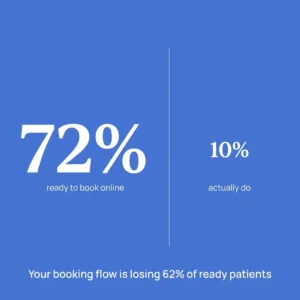
- 72% of patients are willing to book online. Only 10% actually do, because the booking path is too hard.
- 84% of patients read online reviews before choosing a provider, and over half read at least six.
- Improving conversion from 2% to 3.6% on a 2,000-visitor site adds 32 patients and up to $96,000 in annual revenue, with no increase in ad spend.
I design websites and run SEO for doctors and private practices. That work gives me a front-row seat to something I see repeated across almost every practice I audit.
The practice invests in a website. The website looks professional. The appointment book stays half empty.
So I started digging into the numbers behind patient acquisition. What I found points to a fixable set of problems, and a clear order for solving them.
 82% of patients use search engines to find healthcare providers. The average patient checks 3 to 5 provider websites before choosing one. Your site is already inside a comparison process, whether you built it for that or not.
This article breaks down what I’ve learned into a set of best practices you can act on. I’ll walk through the evidence first, then the outline I use with my own clients.
Where Practices Lose Patients Before They Book
Practice websites leak patients. The data shows exactly where.
Healthcare websites convert between 2% and 5% of visitors. Up to 98% of people who land on your site leave without booking, calling, or filling out a form.
Real people with real health concerns found you, looked around, and walked out the digital front door.
The second leak sits in the booking flow itself. Research shows 72% of patients are ready to book an appointment online. Only 10% actually do.
Patients want to book. The path to booking blocks them. That’s the single biggest opportunity in healthcare marketing right now.
💡 Tip: Before you spend another dollar on ads or SEO, test your own booking flow on a phone. Count the clicks from homepage to confirmed appointment. Every extra step costs you patients.
Key Point: The conversion problem is already inside your practice. Traffic isn’t the issue. The path from visitor to booked patient is.
Why Fixing Conversion Is Worth More Than Buying More Traffic
Patient acquisition is expensive, and it’s getting more expensive. Costs in 2026 range from roughly $40 for urgent care to more than $2,500 for behavioral health, with most specialty practices paying between $150 and $600 per new patient.
Marketing budgets keep growing 7 to 10% year over year. Spending more on a leaky system produces a more expensive leak.
A practice receiving 2,000 monthly website visitors that improves conversion from 2% to 3.6% gains an additional 32 patients every month. That represents $48,000 to $96,000 in annual revenue. Same traffic. Same ad spend.
This is why I tell clients that conversion work comes before traffic work. Sending more visitors to a page that turns them away just multiplies the waste.
Key Point: You probably don’t need more traffic. You need your existing traffic to actually book. That’s a design and UX fix, and it pays faster than any ad campaign.
What Do Patients Look At Before Choosing a Provider?
This is the part of my research that surprised me most. I expected referrals to still dominate how patients choose a doctor. The data says otherwise.
Self-directed online search has, for the first time, eclipsed provider referrals as the driving force behind how patients choose care. And within that search, reviews carry the most weight.
84% of patients check online reviews before selecting a healthcare provider, with more than half reading at least six reviews before making a decision.
Nearly 75% of patients turn to reviews as the very first step when searching for a new physician. Reviews are the number one factor in the decision now.
Your reputation lives online before it lives in your waiting room. A practice that ignores its review profile hands the decision to whatever strangers happened to post last.
⚠️ Warning: A polished website next to a two-star review profile still loses the patient. Reputation and web presence work as one system.
Key Point: Patients make the decision before they ever call your office. Reviews are now the front desk. Make sure yours reflects the care you actually deliver.
The Best-Practice Outline I Use With Practices
Here’s the framework I follow when I build a patient acquisition system for a practice. Outcomes first, methods second. That order matters.
01. Fix Conversion Before You Buy Traffic
Your website has one job: turn a visitor into a booked appointment. Everything else supports that job.
Start with the elements the data proves out:
- Physician bios. Websites with physician bios increase appointment requests by 27%. Patients want to see who will treat them.
- Testimonials and star ratings. Displaying them prominently can lift conversion rates by over 270%. Trust signals belong above the fold.
- Speed. Every second of load time drops your conversion rate by around 20%. A slow site charges you a tax on every visitor.
- Accessibility. Medical websites with accessibility optimization see 22% more engagement, and ADA-compliant sites reduce bounce rates by 15%.
None of this requires a redesign from scratch. It requires treating your website like a space patients walk through, and clearing everything that stands between them and the front desk.
Key Point: Small, targeted improvements to your existing site, bios, ratings, speed, and accessibility, outperform a full redesign in most cases. Fix before you rebuild.
02. Own Your Local Search Territory
Patients search locally when they need care. Local SEO generates 61% of organic traffic for medical clinics, making it the highest-converting channel for patient acquisition.
More than 70,000 health-related Google searches happen every minute. Your job is to show up when those searches happen in your neighborhood.
That means a complete and accurate Google Business Profile, location pages that answer real patient questions, and content built around the conditions and treatments people actually search for. I build these pages around search intent, since a page that answers the patient’s question earns the click and the booking.
Key Point: Local SEO puts your practice in front of patients who are already searching for exactly what you offer. Showing up is half the battle.
03. Build a Review Engine, Not a Review Wish
Waiting for happy patients to leave reviews on their own produces a thin, random profile. Building a system produces a steady one.
The system is simple. Ask every satisfied patient at the moment of highest satisfaction. Make the ask a single tap on their phone. Respond to every review, positive and negative, with professionalism.
Given that patients read at least six reviews before deciding, your goal is depth and recency, both of which come from consistency.
Key Point: A review system isn’t about gaming Google. It’s about making sure your online reputation reflects the experience patients actually have in your office.
04. Close the Booking Gap
72% of patients are ready to book online. Only 10% actually do. Closing that gap is a design problem, and design problems have design solutions.
Put a booking button on every page. Keep the form short. Confirm instantly. Test the whole flow on mobile monthly, because that’s where your patients are.
Key Point: Every extra click between a patient thinking about booking and actually booking is a patient you risk losing. Simplify the flow, then test it on mobile every month.
05. Measure What Each Patient Costs You
This step gets overlooked. It’s also the one that turns marketing from a cost into an investment. Organizations investing in digital healthcare marketing see a 4.8x ROI, primarily through patient acquisition.
Healthcare organizations using call tracking and attribution have cut marketing costs by more than 20% and improved ROI by up to 400% within a year. When you know which channel produced which patient, you stop paying for the channels that produce nothing.
Key Point: You can’t improve what you don’t measure. Attribution tells you exactly where to spend more and where to stop.
What This Means for Your Practice
The healthcare digital marketing market sits at $6.4 billion in 2026 and grows 18% annually. Digital advertising now accounts for roughly 76% of total healthcare ad spend. Your competitors are already investing here.
The practices that win follow a learnable sequence. Fix conversion first. Own local search. Build reviews systematically. Remove booking friction. Measure everything.
Patients are already searching for what you offer. They’re comparing you to four other providers before they pick up the phone. The question is whether your website gives them a reason to choose you, or reasons to keep scrolling.
Start with one step this week: run your site through a speed test, click through your own booking flow, and read your last ten reviews the way a new patient would.
You’ll see exactly where your appointment book is leaking. Then you can fix it.
Frequently Asked Questions
How long does it take for healthcare SEO to produce results?
Local SEO typically shows measurable movement in 3 to 6 months for competitive markets. Google Business Profile optimizations can produce visibility improvements faster, sometimes within weeks. The longer you wait to start, the longer competitors hold those spots.
Do I need to be on social media to attract patients?
Social media helps with awareness, but it isn’t the highest-converting channel for practices. Local SEO and a well-converting website consistently outperform social for driving booked appointments. Social works best once the core acquisition system is solid.
What’s the most common reason practice websites don’t convert?
Two things come up consistently. The booking flow has too many steps, and there aren’t enough trust signals, bios, reviews, credentials, near the top of the page. Patients make fast decisions. If they can’t find what they need in the first few seconds, they leave.
Should I respond to negative online reviews?
Yes, always. A professional response to a negative review tells prospective patients that you take feedback seriously and communicate well. Ignoring negative reviews signals the opposite. Keep responses brief, avoid clinical detail, and always offer to continue the conversation offline.
How do I know which marketing channel is bringing in patients?
Call tracking, UTM parameters on your website links, and asking patients directly at intake how they found you are the three most reliable methods. Even basic attribution gives you data that dramatically improves where you put your budget.
Is online booking really necessary for a medical practice?
The data says yes. 72% of patients want to book online. Practices that offer a simple, mobile-friendly booking option see measurably higher conversion rates. Patients who can’t book easily at 9pm on their phone often book with someone who lets them.
How many Google reviews does a practice need to be competitive?
There’s no magic number, but practices with fewer than 20 recent reviews struggle to build trust with new patients. Recency matters as much as volume. A practice with 50 reviews from three years ago competes less effectively than one with 30 reviews from the last six months.
What’s the ROI on improving website conversion for a medical practice?
The math is straightforward. A 2,000-visitor monthly site that improves conversion from 2% to 3.6% gains 32 patients per month. At average revenue per patient, that’s $48,000 to $96,000 annually, with no increase in ad spend. Conversion work is typically the highest-ROI investment a practice can make.
Key Takeaways
- 82% of patients search online before choosing a provider. Your website is already in a comparison process.
- Up to 98% of healthcare website visitors leave without booking. The conversion problem is bigger than the traffic problem.
- 72% of patients want to book online, but only 10% do. Simplifying the booking path is one of the highest-leverage changes a practice can make.
- Reviews are now the number one factor in provider selection. 84% of patients read them before deciding, and over half read at least six.
- Improving conversion from 2% to 3.6% on a 2,000-visitor site produces up to $96,000 in additional annual revenue with no increase in traffic spend.
- Fix conversion first. Then invest in local SEO, review volume, and booking friction. Measurement tells you where to scale.
- The practices gaining patients in 2026 treat their website as a patient acquisition system, not a digital brochure.