
I spend my days inside the websites of doctors and private practices. I look at their traffic, their forms, their booking flows, and their search rankings.
And I keep finding the same pattern.
A practice signs up for SimplePractice or a similar EHR, gets the free website that comes bundled with it, and quietly assumes the patient acquisition problem is solved. Months later, the calendar still has gaps, and nobody can explain why.
Here’s what I found when I dug into it.
 The Numbers Behind the Empty Calendar
 The Numbers Behind the Empty Calendar
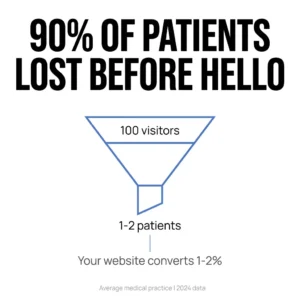
Medical practices lose up to 90% of potential patients through inefficient lead handling and operational failures. That figure stopped me the first time I read it, and it matches what I see in real practice data.
The average practice website converts only 1% to 2% of visitors into leads. Meanwhile, the top 25% of healthcare landing pages hit 20.4% conversion rates.
That gap is enormous. And in 99% of practices, the website is the number one opportunity for new patient acquisition, second only to referrals.
Your website is doing the heaviest lifting in your business, and it usually receives the least investment.
💡 Tip: Pull your website analytics right now and divide monthly form submissions by monthly visitors. If the result is under 3%, you’re leaving patients on the table every single day.
Where SimplePractice Actually Stops
Let me be fair here. SimplePractice does its core job well. Scheduling, notes, billing, telehealth. For a solo practitioner managing existing patients, it works.
The problem starts when you expect it to grow your practice. I looked into the platform’s actual capabilities, and three limitations kept surfacing.
1. No API, No Automation
SimplePractice offers no API access or webhook support. You cannot connect it to Zapier in any meaningful way. You cannot integrate it with custom systems.
Why does this matter for patient acquisition? Because response time is the single most decisive factor in converting a lead. Leads contacted within 5 minutes are 21 times more likely to qualify than leads contacted after 30 minutes. Practices responding within 10 minutes convert leads 70 times better than practices waiting an hour.
Speed like that requires automation. A closed system makes it nearly impossible.
2. Reporting That Can’t Answer Your Growth Questions
The platform’s reporting stays rudimentary. Utilization rates, payer mix analysis, and clinician productivity comparisons are absent or thin.
You can’t improve what you can’t measure. When your software hides the data, every growth decision becomes a guess.
3. Rising Costs for Basic Features
SimplePractice recently raised its monthly subscription prices. Features like calendar synchronization now require the top-tier plan. Phone support is unavailable on lower tiers.
You end up paying more for a system that still leaves the growth side of your practice empty.
Administrative work is eating clinical time, and practices are buying their way out of manual scheduling, billing, and reporting. The demand now goes far beyond basic EHR functionality. (Guideflow, medical practice software analysis)
The Real Comparison Isn’t EHR vs. EHR
This is where I want to offer my honest opinion, because I think the framing of this decision is commonly misunderstood.
Practices compare EHR feature lists against each other. Telehealth here, e-prescribing there. That comparison misses the actual bottleneck.
The bottleneck is the front door.
Keep SimplePractice for your clinical records if it serves you. My argument is about everything that happens before a patient enters that system. The search result. The website. The form. The booking flow. The first five minutes after someone reaches out.
Here’s what I do differently, and why I believe a specialized web design and SEO practitioner beats a bundled software website every time.
01. Conversion-Focused Design
I don’t just make your website look professional. I design every page around one job: turning a visitor into a booked appointment.
The data supports this focus. Proper targeting and design increases visitor-to-lead rates by over 300%. Healthcare websites optimized correctly see 200% to 500% improvements in conversion rates.
Template websites from EHR vendors optimize for nothing. They exist so the vendor can check a box.
02. Data-Driven SEO
82% of smartphone users turn to a search engine when looking for a local medical practice. 62% of smartphone owners use their device to look up health information.
If you rank on page three, those searches belong to your competitors. I build your search presence around what patients in your area actually type, then measure rankings and adjust monthly.
03. Speed and Measurement
For every second your page takes to load, your conversion rate drops by around 20%. I treat page speed as a revenue metric.
I also track everything. Traffic sources, form completions, call clicks, ranking movement. You see exactly where new patients come from. That transparency is the reporting layer your EHR never gave you.
⚠️ Warning: A slow bundled website silently taxes every marketing dollar you spend. Ads and referrals both land on the same slow page.
What This Looks Like in Practice
The market context makes the timing relevant. Medical practice management software is a roughly $8 to $10 billion market in 2024, projected to reach $14 to $21 billion by 2033. Money is pouring into internal operations software.
Patient acquisition remains the underinvested side. That’s where the leverage sits.
Here’s the setup I build for practices:
- A website you own. Your domain, your content, your asset. It stays with you regardless of which EHR you use next year. I think of it as owning your storefront instead of renting a corner in someone else’s building.
- Pages built for local search. Service pages and location signals that put you in front of the right people at the moment they search.
- Booking paths measured in clicks. Fewer steps between “I found you” and “I’m scheduled.” Fast forms, click-to-call, clear next actions.
- Monthly reporting in plain language. Visitors, leads, rankings, and what I’m doing next. You always know what your investment produces.
Your EHR keeps handling the clinical work. Your website starts handling growth. Both jobs get done by the tool actually built for them.
My Honest Take
I’ll say the quiet part directly. EHR vendors benefit when you believe their bundled website is enough. It keeps you inside their ecosystem, on their subdomain, paying their rising subscription fees.
The conversion data tells a different story. A 1% to 2% conversion rate on the channel responsible for most of your new patients is a leak, and it compounds every month you leave it open.
I’ve noticed that practices that measure their conversion rate and invest in their front door fill their calendars faster than practices that keep upgrading their back office. This is commonly overlooked because the back office software sends the invoice and the website just sits there, quietly underperforming.
You deserve a website that earns its keep.
Where to Start
Start with three numbers this week:
- Your monthly website visitors.
- Your monthly new patient inquiries from the website.
- Your average response time to a new inquiry.
Those three numbers tell you more about your growth ceiling than any EHR feature list.
And if you’d like a second set of eyes on them, reach out. I help doctors and private practices turn their websites into consistent patient acquisition tools through conversion-focused design and data-driven SEO, right here from New York City.
Send me your website. I’ll tell you honestly where the leaks are, with numbers, and what fixing them is worth to your practice. No hard sell. Just a conversation about your front door.