
I’ve worked with medical practices across New York City for years, building WordPress sites and optimizing them for search. And I’ve watched something disturbing unfold.
Practices ranking on page one for competitive terms like “cardiologist near me” or “orthopedic surgeon Manhattan” are getting fewer appointment requests than they did three years ago. Same rankings. Less traffic. Fewer patients.
The data confirms what I’ve been seeing in the trenches.
A long-term study of major U.S. publishers found keyword rankings surged from 2015 to 2026, but organic traffic grew far more slowly. The gap started widening around 2016 and never closed. Ranking growth stopped reliably translating into visitor growth.
For medical practices, this isn’t just a traffic problem. It’s a patient acquisition crisis.
 What Changed: The Zero-Click Healthcare Search
 What Changed: The Zero-Click Healthcare Search
Patients are getting answers without ever visiting your website.
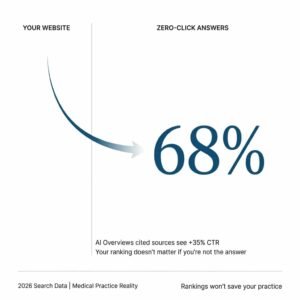
68% of Google searches now end without any click in early 2026, up from 60.45% in 2024. A 7.56-point jump in two years.
For searches triggering AI Overviews, the zero-click rate jumps to 83%.
Here’s what happens when a patient searches “when should I see a cardiologist” or “how long does ACL surgery recovery take.” Google’s AI pulls an answer from multiple sources, synthesizes it, and displays it at the top of the page. The patient reads it, trusts it, and moves on.
Your practice might be ranking #3 for the query. You might have written the most thorough, medically accurate page on the topic. But if you’re not cited in the AI-generated answer, you’re invisible.
The game isn’t about moving from position 4 to position 2 anymore. It’s about being cited as the authoritative source when a patient asks an AI about your specialty.
The Citation Premium: Being THE Answer Pays Off
Here’s the opportunity buried in the crisis.
Websites cited within AI Overviews earn 35% higher organic click-through rates and 91% higher paid click-through rates compared to non-cited competitors on the same queries, according to Seer Interactive’s November 2025 study.
One AI citation generates more qualified patient traffic than ranking #3 in traditional results.
I’ve seen this play out with practices I work with. A dermatology clinic in Queens started getting cited in AI Overviews for “difference between eczema and psoriasis” and “when to see a dermatologist for acne.” Their traffic from those queries doubled, even though their traditional rankings stayed the same.
The patients who clicked through were further along in their decision process. They’d already read the AI summary, trusted the source, and wanted to book an appointment.
Why Traditional SEO Strategies Are Failing Medical Practices
Most medical practice websites are built around a strategy working in 2015 but failing in 2026.
The strategy looked like this:
- Create service pages targeting keywords like “cardiologist NYC” or “orthopedic surgeon Manhattan”
- Write blog posts on broad educational topics like “what is a heart attack” or “types of knee injuries”
- Build backlinks from local directories and medical associations
- Optimize meta titles and descriptions
- Wait for rankings to climb
This approach still gets you ranked. But it doesn’t get you cited.
Major publishers like HubSpot saw organic traffic collapse 70-80% between late 2024 and early 2025 after building massive libraries of broad educational content. Meanwhile, the Professional Publishers Association documented click-through rate declines of 10-25% year-over-year despite stable or improving rankings.
One lifestyle publisher’s click-through rate dropped from 5.1% to 0.6% on a popular query despite still ranking on page one.
Medical practices face the same risk if they rely on generic educational content without clear signals of expertise, authority, and trustworthiness.
Enter AEO: Answer Engine Optimization
Nearly 20.5% of internet users now prefer voice search tools and generative search engines like ChatGPT for quick answers to queries, according to a 2024 study.
Healthcare organizations not structuring content for AI retrieval are already losing patients before the first visit.
Answer Engine Optimization structures content so AI systems find it, understand it, and cite it.
For medical practices, this means building content around direct patient questions with proper schema markup, author credentials, and signals telling AI systems “this source is medically credible.”
Here’s what this looks like in practice:
Old approach: A blog post titled “Heart Health Tips” with 1,200 words of general advice about diet, exercise, and stress management.
New approach: A structured FAQ page answering specific questions like “What’s the difference between a heart attack and cardiac arrest?” with clear author credentials, medical review dates, and schema markup telling AI systems exactly what question is being answered and who’s answering it.
The old approach might rank. The new approach gets cited.
What AI Systems Look For in Medical Content
AI systems don’t just read your content. They evaluate whether it’s trustworthy enough to cite.
For medical content specifically, AI systems look for:
- Author bios with credentials: Links to LinkedIn profiles, university affiliations, board certifications
- Medical review dates: “Last medically reviewed on [date] by Dr. [Name]”
- Citations to peer-reviewed sources: Studies, medical associations like the AMA or ADA, government health resources
- Structured data markup: FAQPage schema, HowTo schema, medical entity markup signaling credibility and expertise
- Specific answers to specific questions: Not broad overviews, but direct responses to what patients are asking
This isn’t optional SEO anymore. It’s the infrastructure determining whether your practice gets cited or ignored when a prospective patient asks an AI about your specialty.
The Mid-Sized Practice Squeeze
Analysis of the top 40,000 U.S. sites shows the largest sites grew organic traffic by 1.6%, while declines were concentrated among mid-sized publishers ranked between the top 100 and 10,000.
That’s exactly where most medical practices and healthcare providers sit.
AI Overviews appear in about 30% of queries overall, but primarily on informational queries. The kind patients ask when researching symptoms, treatments, and specialists.
Commercial and transactional keywords remain far less affected.
This means practices need to shift content strategy toward transactional intent and citation-worthy expertise. Stop trying to educate everyone about everything. Start answering the specific questions patients ask right before they book an appointment.
Questions like:
- “How do I know if I need to see a cardiologist?”
- “What happens during a colonoscopy?”
- “How long is recovery from rotator cuff surgery?”
- “What’s the difference between an MRI and a CT scan?”
These are high-intent queries. Patients asking these questions are close to making a decision. If your practice is cited as the authoritative answer, you’re the one they call.
The Practical Shift: Stop Obsessing Over Rankings
I still track rankings for the practices I work with. But I don’t optimize for them anymore.
I optimize for citations.
Here’s what this means:
- Building content around patient questions, not keyword volume
- Adding clear author credentials and medical review processes to every clinical page
Implementing schema markup telling AI systems exactly what question is being answered and who’s answering it
- Linking to authoritative medical sources to signal credibility
Structuring content so AI systems extract and summarize it as the definitive answer
The goal isn’t to rank #1 for “cardiologist NYC.” The goal is to be cited when a patient asks “when should I see a cardiologist” or “what are the symptoms of heart disease.”
One dermatology practice I work with started structuring their content this way six months ago. Their traditional rankings stayed roughly the same. But their traffic from AI-cited queries increased 40%, and appointment requests from organic search increased 28%.
The efficiency cliff reversed. Same rankings, more traffic, more patients.
What This Means for Your Practice Right Now
If you’re still measuring success by keyword rankings, you’re measuring the wrong thing.
The question isn’t “Where do we rank for our target keywords?”
The question is “Are we being cited as the answer when a patient asks an AI about our specialty?”
If the answer is no, you’re losing patients to practices doing this work.
I help medical practices in New York City and beyond build WordPress websites AI systems recognize as authoritative sources. This means structured content, proper schema markup, clear credibility signals, and answers to the specific questions your patients are asking.
If you want to talk about how to position your practice for AI-powered search, I’m here. You reach me through my website or give me a call. I’ll walk you through what’s working, what’s not, and what needs to change to keep your practice visible when patients search for the care you provide.
The efficiency cliff is real. But it’s not insurmountable. You need to stop playing the old game and start playing the new one.