
Here’s what I’ve learned working with medical practices in New York: the ones who keep their websites current win. The ones who wait? They watch patients walk straight to competitors who moved faster.
Your medical website isn’t a digital business card anymore. Seventy-five percent of patient journeys now start online. Your website is your front door. Patients are judging your care quality before they meet your staff.
When’s the right time for a refresh? I’ve found seven clear signals. If you’re seeing these, you need to act.
 Signal #1: Your Website Makes the Wrong First Impression
 Signal #1: Your Website Makes the Wrong First Impression
Blink. You’ve got 0.05 seconds. Studies show users form opinions about websites faster than a heartbeat.
An outdated design tells patients your medical technology might be behind too. The data backs this. About 75% of visitors judge trustworthiness based on website design. Stanford University found 46.1% of users judge credibility based on website design alone.
If your website looks five years old, patients assume your practice operates five years behind.
I help medical businesses create websites starting from the first 0.05-second impression. Your design builds trust or creates doubt. No middle ground.
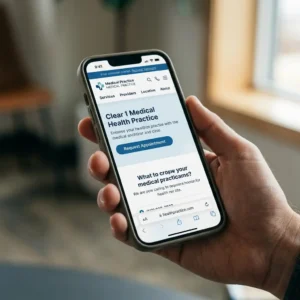
Signal #2: Mobile Users Can’t Navigate Your Site
Over 60% of healthcare searches happen on phones. 85% of adults say mobile-friendly websites are required for healthcare providers.
What this means: if your medical website isn’t mobile-responsive, you’re turning away most potential patients.
I test websites on phones, not desktop browsers set to mobile view. Your site needs to be thumb-friendly. Buttons need to be tappable. Text needs to be readable without zooming. Forms need to work without frustration.
When a patient searches for “urgent care near me” on their phone at 8pm, your mobile experience determines whether they call you or your competitor.
Mobile responsiveness isn’t optional. It’s the baseline.
Signal #3: Your Page Speed is Costing You Patients
Google’s 2026 updates raised the stakes. Since March 2026, Google penalizes sites taking longer than 2.5 seconds to load. Not a suggestion. A ranking factor.
The conversion data is even more telling. Websites loading in 1 second have a conversion rate three times higher than those loading in 5 seconds. Five times higher than those taking 10 seconds.
For medical practices where every lead counts, slow loading times translate to lost patients and lost revenue.
I optimize WordPress websites for speed because I’ve seen the impact firsthand. A practice reduces load time from 6 seconds to 2 seconds and sees big increases in appointment bookings. Patients won’t wait for your site to load when another practice’s site appears instantly.
Speed isn’t a technical detail. It’s a conversion factor.
Google’s New Visual Stability Index
In early 2026, Google introduced the Visual Stability Index (VSI). If your layout shifts while a patient tries to click a button, your rankings drop. Period.
This new ranking factor means outdated websites with poor technical foundations will see big drops in search visibility. For medical businesses relying on organic traffic, updates aren’t recommended. They’re urgent.
Signal #4: Your Conversion Rate Tells the Real Story
On average, healthcare websites convert between 2% and 5%. Up to 98% of potential patients leave without scheduling.
The top 25% of healthcare landing pages average 20.4% conversion. See the gap? That’s why you need a refresh.
I build WordPress websites to convert visitors into patients. Clear calls-to-action. Simple appointment booking. Forms working on mobile devices.
If your website gets traffic but doesn’t generate appointments, the problem isn’t your marketing. It’s your website.
A refresh focused on conversion optimization transforms patient acquisition. You don’t need more traffic. You need a website converting the traffic you’ve got.
Signal #5: You’re Missing Essential Features Patients Expect
70% of patients value access to medical records most. Modern healthcare websites need integrated patient portals and online scheduling. Not next year. Now.
Displaying testimonials and star ratings prominently on your website increases conversion rates by over 270%.
If your website lacks these features, a refresh is overdue.
I help medical practices integrate:
- Online appointment scheduling that syncs with your practice management system
- Patient portals for secure access to records and test results
- Review integration that displays your reputation prominently
- HIPAA-compliant contact forms that protect patient privacy
- Clear service descriptions that help patients understand what you offer
These aren’t luxury features. They’re baseline expectations for 2026. Your patients expect them. Your competitors offer them.
Signal #6: You’re Not Meeting ADA Compliance Standards
ADA (Americans with Disabilities Act) compliance is becoming standard for healthcare website design. Not optional. Standard.
Beyond legal requirements: an accessible site is easier for elderly patients to use. Seniors make up a large portion of healthcare consumers.
Older websites lacking accessibility features put medical practices at legal and competitive risk. You’re exposed on two fronts.
I build WordPress websites with accessibility from the start. Proper heading structures, alt text for images, keyboard navigation, color contrast, screen reader compatibility. All of this.
An accessible website serves more patients. It’s good business and the right thing to do.
Signal #7: You’re Following the Industry Standard Timeline
Healthcare website redesigns are recommended every 2 to 3 years to keep up with technology, user expectations, and compliance standards. This isn’t random. This is the pace of change.
This benchmark gives you a timeline for planning updates. No guesswork.
If your website is approaching or past the three-year mark, you need to be thinking about a refresh. Technology moves fast. Patient expectations change. Competitors improve their digital presence. Staying current requires regular updates.
I work with medical practices to plan refreshes aligning with business goals and budget cycles. Sometimes a full redesign makes sense. Other times, updates to specific sections deliver what you need.
What a Medical Website Refresh Actually Involves
When I refresh a medical website, I focus on outcomes first. What matters is what the website achieves.
The goal? A website that does this:
- Loads in under 2.5 seconds on mobile and desktop
- Converts at least 5% of visitors into appointment requests
- Ranks well in local search results for your key services
- Meets ADA compliance standards
- Provides the features patients expect in 2026
- Represents your practice accurately and professionally
I build WordPress websites because they’re flexible, secure, and easy for your team to update. You don’t need to call me every time you want to change office hours or add a new provider. You have control.
The process starts with understanding your practice, your patients, and your goals. Then I create a design working for your situation. Not a template. A website built for your medical business.
The Cost of Waiting Too Long
I’ve seen medical practices wait until their website hurts business before investing in a refresh. By then, they’ve lost patients to competitors with better websites.
Practices doing well? They view their website as an investment in patient acquisition, not an expense to minimize.
Your website works 24 hours a day, seven days a week. It’s your hardest-working employee.
When you invest in a refresh at the right time, you’re investing in every patient interaction at your digital front door.
How to Know if You’re Ready
You’re ready for a website refresh if you answer yes to any of these:
- Is your website more than three years old?
- Does your site take more than 3 seconds to load?
- Do patients struggle to book appointments online?
- Is your site difficult to use on mobile devices?
- Are you losing patients to competitors with better websites?
- Does your website lack patient portal integration?
- Have you received feedback that your site looks outdated?
- Are your conversion rates below 5%?
If you answered yes to even one, you need a refresh. Not next quarter. Now.
I’m here to help you create a WordPress website attracting patients and representing your medical practice how you want. I work with medium and large service businesses in New York and beyond.
Your website should work as hard as you do. If not, let’s talk about fixing this.