
Medical queries trigger AI Overviews at a rate of 44.1%, more than double the average across all search types. By December 2025, the rate climbed to 88% for healthcare queries.
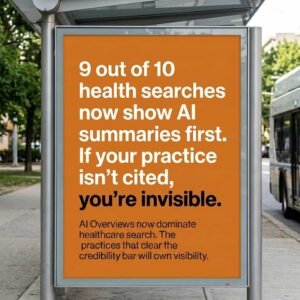
Nearly 9 out of 10 informational health searches now feature AI-generated summaries at the top of search results.
If your practice isn’t showing up in those summaries, you’re invisible to a growing segment of potential patients. I help doctors and private practices turn their websites into consistent patient acquisition tools, and this shift represents the biggest change to healthcare visibility since Google introduced local pack results.
Here’s the opportunity: AI applies stricter credibility filters to medical content than to any other category, and this creates a moat. Most practices won’t clear the bar. The ones who do will dominate informational search visibility for their specialties.
 Why Healthcare Gets Different Treatment (And Why That’s Good News)
 Why Healthcare Gets Different Treatment (And Why That’s Good News)
Google classifies health content as “Your Money or Your Life” (YMYL). Any information directly affecting a person’s health triggers a stricter evaluation process.
The margin for thin, generic, or unverified content is zero.
A home services company publishes mediocre blog posts and still ranks. A medical practice does not. AI citation algorithms inherit these same filters. When ChatGPT, Perplexity, or Google AI Overviews evaluate whether to cite your practice, they’re checking for signals proving clinical authority.
This creates a barrier to entry working in your favor once you understand the rules.
The Local Search Exception (Your Two-Layered Strategy)
Google tested AI Overviews on queries like “dermatologist near me” and “cardiologist near me,” then removed them entirely. Local healthcare provider searches went from 100% AI Overview coverage in December 2023 to 0% in December 2025.
Local searches are handled by traditional results: Maps, local pack, organic listings.
Informational searches show the opposite pattern. Treatment queries show 100% AI Overview presence. Pain-related queries show 98%. Symptom queries show 93% coverage.
Your strategy needs two layers:
Layer 1: Traditional local SEO for “near me” and provider-finding queries. This drives appointments directly.
Layer 2: AI citation optimization for informational queries about conditions, symptoms, and procedures. This builds authority and captures patients earlier in their research journey.
The practices who win are the ones who execute both.
The 5 Core Signals That Determine AI Citations
I’ve analyzed hundreds of medical practice websites and tracked which ones get cited in AI Overviews. The pattern is consistent. Five signals determine visibility.
1. Credential Clarity on Provider Pages
AI engines weigh source credibility before including content in an answer. Google penalizes health content lacking clear author credentials, effectively removing the content from featured snippets and AI Overview consideration.
Your provider pages need:
- Degree (MD, DO, DDS, etc.)
- Board certification with specialty
- License state
- NPI number (National Provider Identifier)
- Years in practice or residency completion year
- Hospital affiliations if applicable
These aren’t nice-to-haves. They’re the difference between being cited and being ignored.
A pediatric dermatology practice I worked with added board certification details and NPI numbers to their provider bios. Within 60 days, they appeared in AI Overviews for “pediatric eczema treatment” and “infant skin rash diagnosis.” The traffic from those citations converted at 12% to appointment requests.
2. Content That Answers Real Patient Questions
Informational queries surface AI Overviews 66.9% of the time. Long-tail queries (7+ words) trigger them at 73.9%.
Your content needs to reflect the questions patients ask:
- “What causes lower back pain after sitting?”
- “How long does recovery take after ACL surgery?”
- “Can I exercise with plantar fasciitis?”
Build condition pages, procedure pages, and FAQ pages around these queries. Use hedged language. Medical content making absolute outcome claims (“This treatment cures X”) gets filtered out. Content explaining possibilities (“This treatment reduces symptoms in 70-80% of patients”) gets cited.
Add a “medically reviewed by” date to every clinical page. AI algorithms check for recency as a proxy for current standards of care.
3. Schema Markup (The Machine-Readable Layer)
Schema tells AI engines what your content represents. Four types matter for medical practices:
- Physician schema on provider pages
- MedicalOrganization schema on your homepage
- MedicalClinic schema with specialty designation
- FAQPage schema on content pages
This is technical work, and it’s not optional. Schema is how you tell the AI what credentials to look for and what questions you’re answering.
4. Online Reputation (Reviews as Trust Signals)
Review signals increasingly influence visibility in AI-assisted search, especially in YMYL categories with higher trust thresholds.
A practice with 60 reviews from the last 12 months outranks a practice with 200 reviews where the most recent is 14 months old. AI weights freshness as a proxy for current quality. Recency matters more than volume.
Your target: reviews above 4.6 stars, with at least 40% posted in the last 12 months.
AI reads review text for clinical specificity. A pediatric dermatology practice with reviews mentioning “eczema,” “patient with sensitive skin,” and “explained the treatment plan to my daughter” surfaces for pediatric-skin searches in ways a practice with generic “great experience” reviews won’t.
The first set tells the AI what the practice is good at. The second set tells the AI nothing.
Respond to reviews. AI algorithms interpret response rate as a signal of practice engagement and patient care quality.
5. NAP Consistency Across All Directories
NAP stands for Name, Address, Phone. Inconsistencies across directories (Google Business Profile, Healthgrades, Zocdoc, Vitals) create ambiguity. AI citation algorithms penalize ambiguity in YMYL categories.
Your practice name, address format, and phone number need to match exactly across every listing. “123 Main St” on one profile and “123 Main Street” on another? Conflict.
Fully verified and complete Google Business Profiles appear more often in AI-driven summaries, generating 4× more website visits compared to unverified listings.
Platform Differences: Google vs ChatGPT vs Perplexity
Each AI platform has different source preferences. Your optimization strategy accounts for this.
Google AI Overviews pull 97% of cited sources from the top 20 organic results. If you’re not ranking organically for a query, you won’t get cited in the AI Overview. Google prioritizes sites with clear author credentials and favors content from established medical institutions. Private practices compete by demonstrating local expertise and patient outcomes.
ChatGPT favors high-authority content like Wikipedia (47.9% of top citations) and major publications. For private practices, this means your best path to citation is through local news coverage, medical association directories, and patient education content other authoritative sites link to.
Perplexity returns 21+ sources per medical answer on average, prioritizes peer-reviewed literature, and uses PubMed and clinical trial databases as primary sources. Perplexity is less accessible for private practices unless you’re publishing case studies or contributing to medical journals. Worth monitoring for specialty-specific queries.
Your primary focus should be Google AI Overviews. The patient volume lives there.
Anti-Patterns to Avoid (What Kills Your Chances)
Three mistakes consistently disqualify practices from AI citations:
Vague marketing bios. “Dr. Smith is a highly skilled, compassionate provider dedicated to patient-centered care.” This tells the AI nothing about credentials, specialty, or clinical authority. Replace with: “Dr. Smith is a board-certified orthopedic surgeon specializing in sports medicine. She completed her residency at Johns Hopkins and has treated over 3,000 ACL injuries in her 12-year practice.”
Missing “medically reviewed” dates. If your condition page doesn’t show when a physician last reviewed the content, AI algorithms assume the information is outdated. Add a review date and update annually.
Absolute outcome claims. “Our treatment eliminates chronic pain” or “We guarantee results” triggers YMYL penalty filters. Use evidence-based language: “Clinical studies show this treatment reduces chronic pain in 75-85% of patients.”
The Traffic Reality: Why This Still Matters
When Google gives an AI Overview, organic click-through rates drop to 0.6%, compared to 1.6% with no AI Overview. 61% decline.
Traffic from informational content gets consumed inside the search experience.
The searches driving appointments (local provider searches) remain traditional SEO territory. Even with reduced click-through rates, citations in AI Overviews build authority influencing patient decisions when they search for a provider.
RepuGen’s research shows 39.7% of patients use AI directly to research healthcare providers. Among patients adopting AI tools, 57% of their research happens through AI.
You’re not optimizing for clicks on informational queries. You’re optimizing for trust, authority, and top-of-mind awareness when those patients eventually search for a provider.
Your Implementation Checklist
Here’s what to do this week:
Audit your provider pages. Add degree, board certification, license state, and NPI to every physician bio. If this information isn’t visible, you’re invisible to AI.
Identify your top 10 patient questions. Pull them from intake forms, front desk logs, and review comments. Create FAQ pages or expand existing condition pages to answer them. Use hedged, evidence-based language.
Add schema markup. Implement Physician, MedicalOrganization, and FAQPage schema on relevant pages. If you don’t have a developer, tools like Schema Pro or Rank Math (for WordPress) help.
Request recent reviews. Send follow-up emails to patients from the last 90 days asking for feedback. Include direct links to your Google Business Profile. Respond to every review within 48 hours.
Verify NAP consistency. Check your practice name, address, and phone number across Google Business Profile, Healthgrades, Zocdoc, Vitals, and any other directory where you have a listing. Fix discrepancies.
Add “medically reviewed” dates. Every condition page, procedure page, and clinical FAQ needs a visible review date and the name of the reviewing physician.
This isn’t theoretical. I’ve built patient acquisition systems for practices appearing in AI Overviews for their core specialties. The ones executing this checklist see results within 60 to 90 days.
The window is open. Most practices won’t do this work. The ones who do will own informational search visibility in their markets.
If you want help implementing this for your practice, I’m here. I design conversion-focused websites and execute data-driven SEO for doctors and private practices. This is what I do.