
TL;DR: A small dental practice was making $35k/month with an 85% bounce rate and a booking page that broke half the time. I rebuilt their site in two weeks, wrote content targeting real patient fears, and they hit $300k/month in 70 days. SEO moved fast because the content matched what patients were actually typing.
- 85% bounce rate traced directly to a broken booking page, not a traffic problem
- Full site rebuild in WordPress with HIPAA-compliant forms took two weeks from first Zoom to launch
- Content targeted patient fears: pain, cost, insurance, location. Real questions, answered plainly
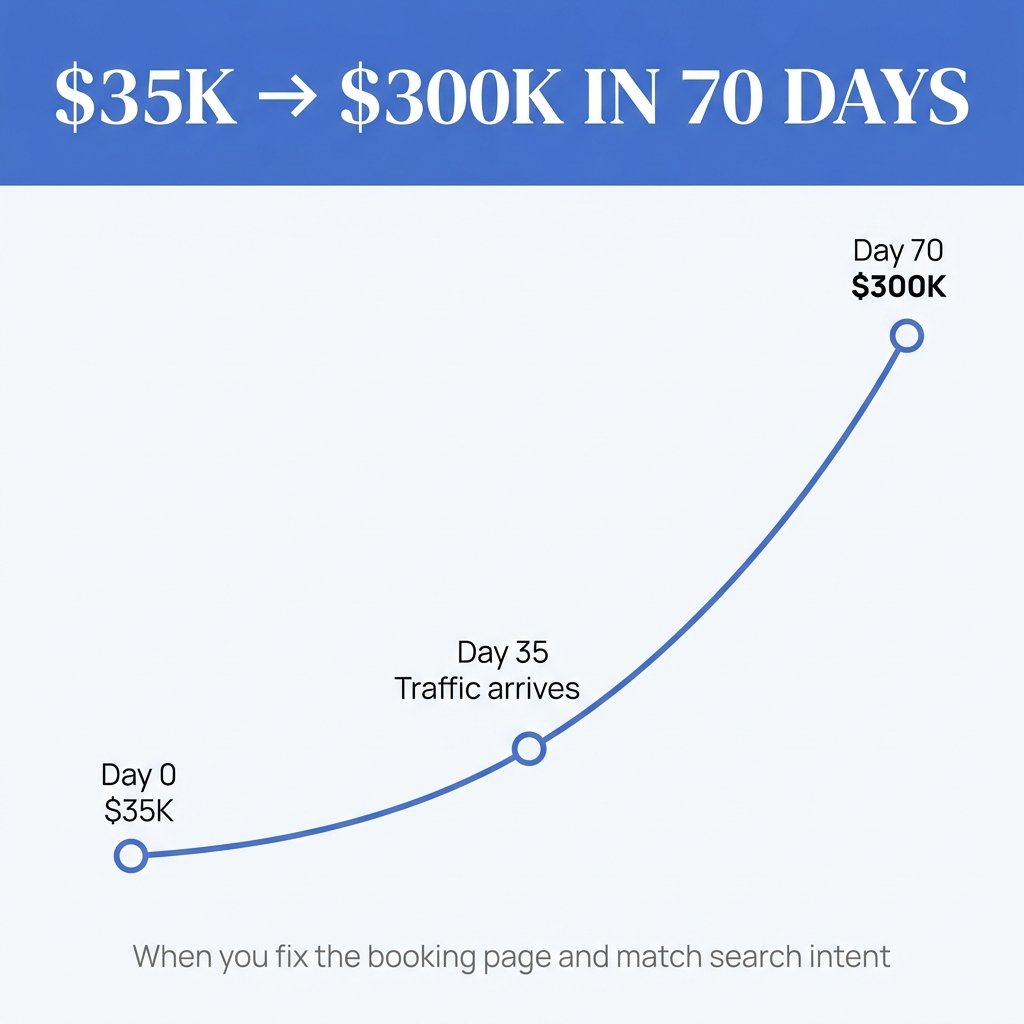
- Local traffic arrived within 30-35 days of the new content going live
- Consistent bookings by day 70. Revenue climbed from $35k to $300k/month
 Practice owners get told SEO takes six months. Sometimes a year. Agencies say it because a long runway buys time before anyone asks about results.
When your content matches what patients actually search for, traction shows up in weeks. I know because it happened with a dental practice doing $35k a month when I first met them.
Seventy days later, patients were booking consistently. The practice climbed to $300k a month.
This is the full story, including the part where the owner didn’t believe any of it would work.
What Did Their Website Look Like Before?
When I first opened their website, I knew right away they were leaving money on the table.
Their old site was like a bike with no wheels, a rusty chain, and crooked handlebars. Technically it existed. It went nowhere.
Here’s what I found:
- Five different fonts across the site
- Buttons in mismatched colors with no consistent style
- A booking page that worked 50% of the time
- A bounce rate around 85%
Out of every 100 people who found this practice online, roughly 85 left without doing anything.
💡 An 85% bounce rate means the funnel barely exists. Traffic arrives, looks around, and walks back out the door.
Bottom line: The site wasn’t a patient acquisition tool. It was a waiting room with the lights off.
Where Was the Revenue Actually Leaking?
Practices in this situation usually assume they have a traffic problem. They start thinking about ads, more content, more channels.
The data told a different story. A large share of potential patients were leaving on the booking page itself. These were people who wanted an appointment. They tried to book. The page failed, and they left.
A revenue leak happening every single day, in real time.
The practice knew the page had issues. They hadn’t faced how much it was costing them. So I showed them exactly how many people came to the site and how many left. The numbers were staggering.
I didn’t have to convince them of anything. The data did the selling. They hired me on the spot.
Key Point: Before spending on traffic or ads, confirm your booking flow actually works. Every dollar spent driving traffic to a broken page is a dollar wasted.
How Did I Fix It? A Full Rebuild in Two Weeks
My first priority was the booking page. Stop the bleeding before anything else.
Once that worked reliably, I looked at the rest of the site. Fixing every individual problem would have taken longer than building a new site from scratch.
So I scrapped it and started fresh.
I built a new site in WordPress with:
- HIPAA-compliant forms so patients could share information safely
- One consistent design system, one font family, one button style
- A booking flow that worked 100% of the time
- Insurance and payment information laid out upfront, easy to find
From our first Zoom meeting to final launch: two weeks.
⚠️ A rebuild sounds drastic. When the foundation is broken, patching individual pages costs more time and money than starting clean. Do the math before committing to patchwork.
Key Point: A full rebuild is sometimes faster and cheaper than fixing a site piece by piece. Two weeks to launch beats six months of band-aids.
What Was the Content Strategy?
This is the part that made the SEO move fast, and it’s the part that gets overlooked.
Practices write content about themselves. Their technology. Their awards. Their mission statement. That’s natural, and it’s almost always the wrong call.
Patients search for their fears.
So I reverse-engineered it. Whatever people were actually searching for, I wrote articles for. That meant content targeting:
- Fear of dental procedures. Pain, anesthesia, what actually happens in the chair.
- Costs. Real numbers, stated plainly, before anyone picks up a phone.
- Insurance. Which plans the practice accepts, listed clearly on the site.
- Payment plans. How payments work, spelled out upfront.
- Location. Local search terms for people looking for a dentist nearby.
Every article answered a question a patient was too anxious to ask out loud.
The strategy sounds simple because it is. The hard part was the mismatch between what the practice wanted to say and what patients needed to hear. Closing that distance is where the results came from.
Key Point: Writing for patient anxiety, not practice achievements, is what drives organic search traffic. Answer the questions patients type when they’re scared, and they show up on your site.
What Did the Results Actually Look Like?
Here’s exactly how it played out after launch:
- Day 1 to 14: Full rebuild, from first Zoom call to live site
- Day 30 to 35: Local traffic started arriving from the new content and SEO work
- First month: Bounce rate dropped from 85% to around 50%
- Day 70: Patients started booking consistently
- Ongoing: Monthly revenue climbed from $35k to $300k
Thirty-five days to visible traffic. Seventy days to consistent bookings. That timeline surprises people who’ve been quoted six months before anything moves.
The traffic came in because the content matched real searches. The bookings came in because the site earned trust the moment someone landed on it, and booking took seconds instead of failing half the time.
Key Point: Speed of SEO results depends on how closely your content matches what patients are already searching. Precision beats volume every time.
When Did the Owner Actually Believe It?
After the site launched, the owner didn’t really believe it was going to change anything.
They’d been burned before. The old site had been broken so long that a website simply doing its job felt unrealistic to them. I get that.
Then the phone calls started. Then the bookings. Then the online forms from people asking how to make an appointment.
Every insurance plan they accepted was on the site. How payments worked was on the site. Patients arrived already knowing the answers, already comfortable, already decided.
Once they understood who their real audience was, marketing got easier. They now know their website works as a salesperson 24/7, even when the practice is closed.
One more thing that mattered. This team genuinely loved helping people smile. That came through in every article we published. The content landed because the care behind it was real. You can’t manufacture that, and patients can tell.
Key Point: Trust is built before the first phone call. When your site answers the questions patients are scared to ask, they arrive ready to book.
What’s the Core Lesson Here?
Transparency converts.
Patients are scared. Scared of pain, surprise bills, insurance rejections, looking uninformed. A website that answers those fears before anyone asks becomes a 24/7 patient acquisition tool.
Three things worth taking from this case:
- Check your booking flow before you buy traffic. A broken booking page turns every marketing dollar into waste.
- Write for the patient’s anxiety. Fears, costs, insurance, and location drive real searches. Answer them plainly.
- Put your prices, insurance, and payment plans upfront. Hiding them creates doubt. Showing them builds trust before the first phone call.
SEO done right brings in the right patients. How fast it works depends on how closely your content matches what those patients are already typing into Google.
Is Your Practice’s Website Actually Working?
If you run a dental or medical practice and your SEO isn’t producing patients, start with two questions.
Does your booking page work every single time? Does your content answer the questions your patients are scared to ask?
If the answer to either one is no, you have a fixable problem. Fix the booking flow. Write content for patient fears. Put the pricing and insurance information where anyone can find it. That’s the whole playbook.
I help doctors and private practices turn their websites into consistent patient acquisition tools through conversion-focused Web Design and data-driven SEO. If you want me to look at your site the way I looked at this one, reach out. I’ll show you exactly where the leak is.
Frequently Asked Questions
How long does SEO actually take for a dental practice?
It depends on how closely your content matches real patient searches. In this case, local traffic arrived within 30-35 days of publishing content targeting specific patient fears. Consistent bookings followed by day 70. Six months is not a given. Precision matters more than time.
What caused the 85% bounce rate?
A combination of visual inconsistency (five fonts, mismatched buttons) and a booking page that only worked half the time. Patients who wanted to book hit a wall and left. The core issue was a broken booking flow, not low traffic.
Why rebuild the entire site instead of fixing individual pages?
Because patching a broken foundation takes longer and costs more than starting clean. The existing site had so many compounding issues that a full rebuild in WordPress was the faster path to a working site. Launch happened in two weeks.
What kind of content drives dental SEO results?
Content that targets patient fears, not practice achievements. That means articles on procedure costs, what to expect in the chair, which insurance plans are accepted, how payment plans work, and location-based searches for nearby dentists. Answer what patients are scared to ask, and they find you.
Does a website redesign alone improve SEO?
A redesign fixes the conversion problem. SEO content fixes the traffic problem. Both are necessary. In this case, the redesign stopped the revenue leak and the content strategy brought in qualified local traffic. One without the other would have delivered partial results.
How important is HIPAA compliance for a dental practice website?
Critical. Any form that collects patient information, whether for booking or inquiries, must be HIPAA-compliant. Non-compliant forms expose the practice to legal risk and erode patient trust. This was built into the new site from day one.
How do you measure whether a dental website is actually working?
Start with bounce rate, time on site, and booking page completion rate. In this case, bounce rate dropped from 85% to around 50% in the first month. That shift directly preceded the spike in consistent bookings. Track where patients drop off, and fix that first.
Can this approach work for medical practices beyond dentistry?
Yes. The core principle applies to any service-based medical practice: write for patient anxiety, make pricing and insurance information visible, and make booking frictionless. Patients searching for a specialist, a therapist, or a primary care doctor carry the same fears. Answer them directly.
Key Takeaways
- An 85% bounce rate is a funnel problem, not a traffic problem. Fix the booking page before spending on ads or SEO.
- A full site rebuild is sometimes the faster, cheaper option. Two weeks to launch beats months of patchwork.
- Patient-focused content outperforms practice-focused content every time. Write for fears, costs, insurance, and location.
- SEO results in weeks are possible when content matches real searches precisely. Six months is not the baseline.
- Transparency builds trust before the first call. Publish your prices, insurance plans, and payment options where anyone can find them.
- The website is a 24/7 salesperson. When it earns trust and makes booking easy, revenue follows.
- From $35k to $300k/month in 70 days. The timeline is real. The playbook is repeatable.