I’ve spent years building websites for service businesses in New York. Medical practices in Queens are sitting on a conversion crisis they don’t know exists.
Your website gets traffic. People find you on Google. They land on your homepage. They leave.
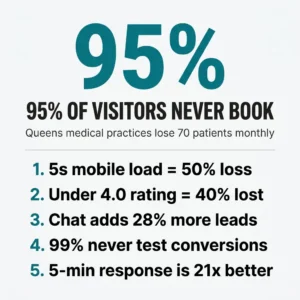
The average medical practice website converts between 2% and 5% of visitors. 95 to 98 out of every 100 people who visit your site never book an appointment. They disappear.
Top-performing practices hit 21% conversion rates.
This is the difference between a practice struggling to fill appointment slots and one with a waiting list.
I’m going to show you what’s broken, what’s working for practices getting this right, and how you fix your conversion problem without rebuilding your entire website.
 The Real Cost of Your Conversion Problem
 The Real Cost of Your Conversion Problem
Do the math on what you’re losing.
Your website gets 1,000 visitors per month and converts at 3%. You get 30 new patient appointments. Optimize to 10% (still below the top performers), you’d get 100 appointments.
70 additional patients per month. 840 per year.
Multiply by your average patient lifetime value. For most practices, we’re talking hundreds of thousands in lost revenue.
The problem gets worse with lead management. Research shows 90% of potential patients get lost through inefficient systems. People fill out forms nobody responds to. Calls go to voicemail. Inquiries sit in inboxes.
Only 40 to 50% of new patient leads result in booked appointments. You’re losing people who already raised their hand and said they want to see you.
Mobile Changes Everything
60% of patients prefer to book appointments online rather than calling. They’re doing this on their phones during their commute, on their lunch break, while waiting in line at the grocery store.
Your website needs to work on mobile. Work, not “look okay.”
Here’s what happens: your site loads slowly on mobile. The appointment form is hard to fill out on a small screen. The phone number isn’t clickable. The insurance information is buried three clicks deep.
Every second your page takes to load, your conversion rate drops by 20%.
Websites loading in under 2 seconds convert 47% better than slower sites. I’ve seen practices lose half their potential patients because their homepage took 5 seconds to load on a phone.
I measure this on every site I build. Page speed directly impacts whether someone books with you or clicks back to Google and tries the next practice.
Why Online Reputation Kills Conversions
84% of patients read online reviews before selecting a provider. Rated below 4.0 stars? You lose 40% of potential patients before they even look at your services.
A single negative review costs you about 30 patients per year.
Someone lands on your website, sees you have 3.2 stars on Google, and leaves to find someone else.
Practices I work with displaying patient testimonials prominently on their site see measurably higher conversion rates. Video testimonials increase conversions by 80% compared to text-only reviews.
Your reputation goes beyond what people say about you. How you display social proof on your website matters.
I build testimonial sections into every medical practice site I design. Not buried on a separate page. Right on the homepage, near the appointment booking section, where people are making their decision.
Features Moving the Needle
Medical practice websites look identical. Blue color scheme. Stock photo of a doctor with a stethoscope. Generic “Welcome to Our Practice” headline.
The sites that convert differently do specific things:
Online chat generates 28% more appointment leads. Patients have a quick question (Do you take my insurance? What are your hours?) and chat answers immediately.
Video content on landing pages raises conversions by 34%. A 60-second video of the doctor introducing themselves builds more trust than three paragraphs of text about credentials.
Displaying wait times, physician credentials, or patient counts near booking buttons increases conversion rates by 25 to 40%. People want to know they’re making a good decision. Give them the information right where they need it.
I add these features because they change behavior. They answer the questions stopping people from booking.
The A/B Testing Gap Costing You Everything
99% of medical and dental practices never conduct A/B testing for conversion rates.
99%.
Almost every practice launches a website, hopes it works, and never tests whether changing the appointment button color, the headline, or the form fields would get more bookings.
I run A/B tests on every site I manage. Sometimes the results surprise me. Moving the phone number above the fold increased calls by 23% for one Queens practice. Changing “Request Appointment” to “Book Your Visit” improved form submissions by 18% for another.
You don’t measure? You don’t optimize.
Practices stuck at 2 to 4% conversion rates focus on making their site look good. The ones hitting 15 to 21% focus on making their site work. They test. They measure. They improve.
Phone Calls Still Win (Your Website Should Know This)
Phone calls convert 25 to 40% of the time compared to 2% for online form submissions.
12 to 20x difference.
88% of healthcare appointments are still scheduled by phone. People prefer online booking, but they still pick up the phone when they’re ready to commit.
Your website needs to make calling easy. Click-to-call buttons on mobile. Phone number in the header, footer, and next to every call-to-action. Multiple ways to reach you.
59% of qualified callers who reach practices never book appointments. More than 25% of calls go completely unanswered.
Your website drives perfect traffic, but if nobody answers the phone, your conversion rate stays at zero.
I help practices set up call tracking so they know which website pages drive calls, which calls convert to appointments, and where people are dropping off. You need to see the full picture.
Lead-to-Appointment Crisis
Let’s say you fix your website. Traffic increases. Form submissions go up. Phone calls come in.
What happens next?
Analysis of 278,000 healthcare leads showed 39.9% of marketing-sourced leads ever book an appointment. 60% of people who expressed interest never become patients.
The practices that win respond within 5 minutes. Not 5 hours. Not the next day. 5 minutes.
Responding within 5 minutes makes you 21 times more likely to convert a lead than waiting 30 minutes.
I build websites that send immediate notifications when someone fills out a form. Email, text, whatever works for your front desk. The faster you respond, the more appointments you book.
This isn’t about technology. This is about treating your website leads like they’re as valuable as the person standing at your front desk. Because they are.
What I Do About This
I build websites for converting visitors into booked appointments.
Here’s how I approach conversion optimization for medical practices in Queens:
First, I audit your current conversion funnel. Where are people dropping off? What pages get traffic but no engagement? Which calls-to-action get ignored?
Second, I optimize for speed. Every page loads in under 2 seconds on mobile. No exceptions. This alone doubles your conversion rate.
Third, I make booking frictionless. Click-to-call buttons. Simple forms. Multiple conversion pathways. Online scheduling if you want it. Phone numbers everywhere.
Fourth, I build trust into the design. Patient testimonials. Physician credentials. Insurance information. Wait times. Everything a patient needs to feel confident booking with you.
Fifth, I set up tracking and testing. You need to know what’s working. I install analytics, call tracking, and A/B testing frameworks so you keep improving.
I don’t use templates. Every medical practice in Queens serves different patients with different concerns. Your website should reflect that.
Practices Getting This Right
Medical practices I work with achieving 15 to 21% conversion rates do a few things consistently:
They treat their website as a patient acquisition system, not a digital brochure.
They respond to leads immediately. Within minutes, not hours.
They test and measure everything. They know which pages drive appointments and which ones need work.
They make it easy to book. Multiple options. Clear calls-to-action. No friction.
They build trust through social proof, credentials, and transparency about wait times and insurance.
Conversion optimization is not a one-time project. It’s an ongoing process.
Your competitors in Queens are leaving money on the table. They’re getting traffic and losing 95% of it. You have a choice.
What You Do Next
Start by measuring your current conversion rate. How many visitors does your site get per month? How many book appointments?
Look at your mobile experience. Pull out your phone right now and try to book an appointment on your own site. Is it easy? Is it fast?
Check your lead response time. When someone fills out a form, how long until your team responds?
Review your online reputation. What do patients see when they Google your practice?
If you’re serious about fixing your conversion problem, I can help. I build WordPress websites for medical practices in Queens that turn visitors into booked appointments. I handle the design, the SEO, the speed optimization, and the conversion tracking.
You can reach me directly to talk about your specific situation. I’ll look at your current site, identify what’s costing you patients, and show you exactly how to fix it.
Your practice deserves better than a 3% conversion rate. Let’s get you to 15%.