

I’ve been building WordPress websites and running SEO campaigns for service businesses in Queens and across New York for years now. And something happened in 2026 that I need to talk about.
Your traffic is dropping. Not because you did something wrong. Not because your competitors suddenly got smarter. And not because your content got worse.
Google changed the game.
I’m watching medium and large service businesses lose 30-40% of their organic traffic year-over-year. Companies that invested thousands in SEO. Sites that rank on page one. Businesses doing everything “right” according to the old playbook.
The data tells a story that most web designers and SEO consultants aren’t ready to admit yet.
The Numbers Don’t Lie
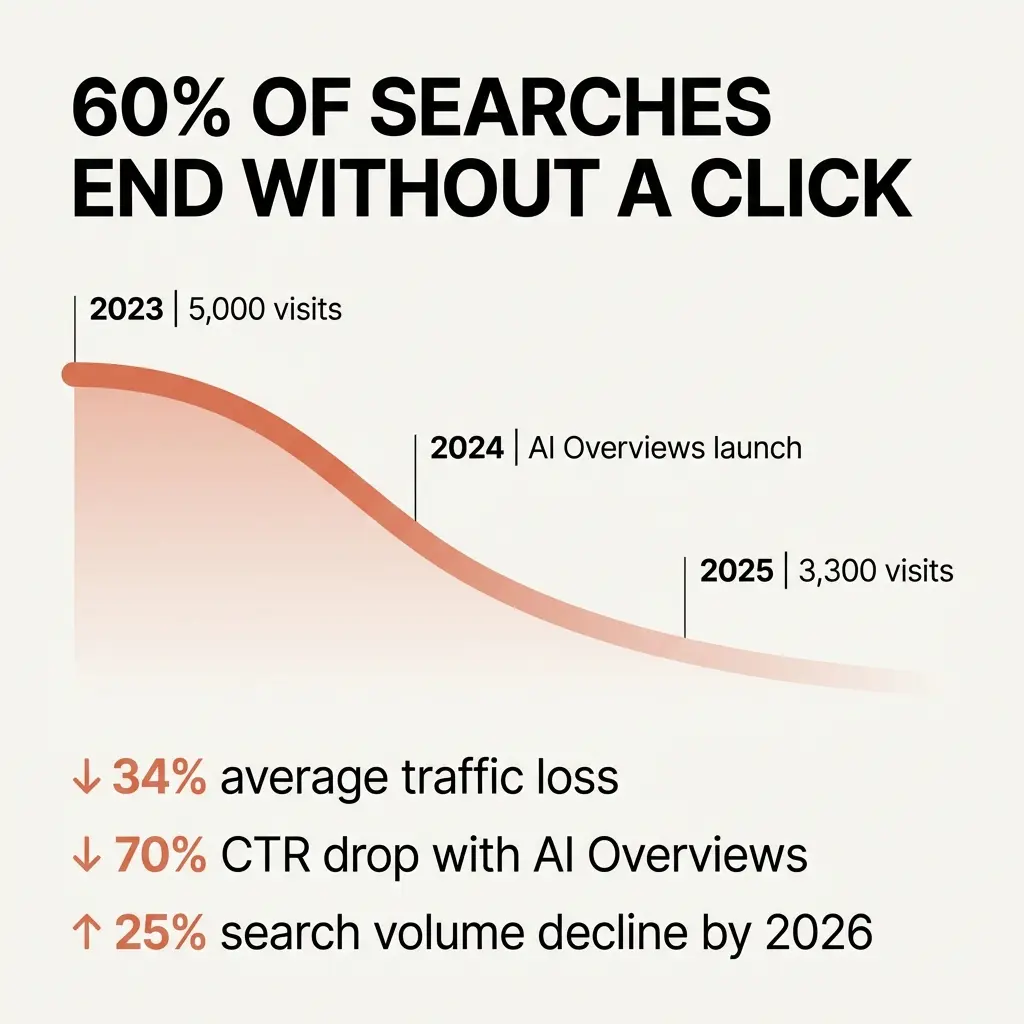
Research firm Gartner forecasts that by 2026, traditional search engine volume will drop 25%. That’s not a minor dip. That’s a fundamental shift in how people find service businesses online.
But here’s what’s happening right now, in 2025:
Almost 60% of Google searches in the US end without a click. People get their answer from featured snippets, knowledge panels, or Google’s new AI Overviews. They never visit your carefully optimized website.
Recent analysis shows that 73% of B2B websites experienced significant traffic loss between 2024 and 2025. The average decline? 34% year-over-year.
I see this in my own client data. Service businesses that were getting 5,000 monthly visitors are now seeing 3,300. Companies that built their lead generation around organic search are scrambling to understand what happened.
What Changed in May 2024
Google rolled out AI Overviews in May 2024. This wasn’t just another algorithm update. This was Google deciding to become an answer engine instead of a search engine.
When Google’s AI Overview appears at the top of search results, organic click-through rates drop by up to 70%. Think about that. You can rank number one for your target keyword and still lose seven out of ten potential visitors.
Digital marketers are calling this “the great decoupling”. Search impressions climb higher than ever. Your site shows up in search results more often. But clicks through to your website drop.
37 of the top 50 news domains saw year-over-year traffic declines. Some plunged 40%.
If major media companies with entire SEO teams can’t maintain their traffic, what does that mean for your service business?
The Zero-Click Search Problem
I need you to understand what a zero-click search means for your business.
Someone searches “how to choose a plumber in Queens.” Google’s AI Overview generates an answer right there. It pulls information from multiple websites, synthesizes it, and presents a complete response. The person gets what they need without clicking anything.
Your website provided the information. Google used your content. But you got zero traffic, zero leads, and zero opportunity to convert that person into a customer.
This is happening across every service industry.
Keywords that previously drove consistent traffic are losing 60-80% of their click-through rates. Even when you maintain the same ranking positions.
Position zero results—those featured snippets that appear above organic listings—now capture 35% of all clicks for informational queries. If you’re not optimized for snippet capture, you’re fighting for scraps from an increasingly smaller pie.
The AI Chatbot Factor
People are asking ChatGPT, Claude, Gemini, and Perplexity for recommendations instead of typing questions into Google.
Data shows that AI chatbot referral traffic to top websites is roughly 96% lower than traditional Google search. When someone asks ChatGPT to recommend a web designer in New York, there’s no link to click. There’s no search result to rank for.
The entire model we built our businesses around—create great content, optimize for keywords, rank high, get traffic—is breaking down.
I’m not saying SEO is dead. I’m saying the way traffic flows to service business websites has fundamentally changed.
What This Means for Your WordPress Site
I build WordPress websites for service businesses because WordPress gives you control. You can optimize, you can publish content, you can adapt to changes faster than businesses stuck on proprietary platforms.
But that control only matters if you understand what you’re controlling for.
The average search query length increased from 2.3 words to 4.1 words. People are getting more specific. They’re asking complete questions instead of typing short keywords.
“Web designer” became “web designer for medical practices in Queens that does SEO.”
Your content strategy needs to match this shift. The blog posts optimized for two-word keywords aren’t capturing traffic anymore. You need content that answers the specific, detailed questions your potential customers are actually asking.
And you need to answer those questions in a way that makes Google want to feature your content in AI Overviews.
The Technical Side You Can’t Ignore
I’ve seen WordPress sites lose 80% of their traffic overnight because of technical issues during site migrations. No proper 301 redirects. Broken sitemap submissions. Caching plugin conflicts that prevent Google from crawling updated content.
Google’s December 2025 Core Update affected approximately 40-60% of websites globally. Service business sites weren’t immune. The algorithm rewarded sites with strong technical foundations and penalized sites with poor mobile experiences.
Mobile devices account for 62.45% of all internet traffic in 2025. If your WordPress site doesn’t deliver a fast, clean mobile experience, you’re losing traffic even before AI Overviews enter the picture.
Here’s what I check on every service business site I work on:
- Page load speed under 3 seconds on mobile
- Proper redirect chains from old URLs
- Clean XML sitemap submission
- Structured data markup for local service businesses
- Regular content updates targeting new keyword variations
The best keywords fall out of favor. You need to keep publishing new content and targeting new keywords to remain relevant. That’s not optional anymore.
What I’m Doing About It
I’m not writing this to scare you. I’m writing this because I’m in the trenches with service businesses trying to maintain and grow their online presence.
Here’s what’s actually working in 2025:
Optimize for AI Overview inclusion. Structure your content to answer complete questions. Use clear headings. Provide definitive answers in the first 100 words. Add context and detail below. Google pulls from content that’s authoritative and well-organized.
Target bottom-of-funnel keywords. People using AI chatbots for general information. They’re still using Google when they’re ready to hire someone. Focus on keywords with commercial intent. “Hire web designer Queens” gets fewer searches than “what is web design,” but the people searching it are ready to buy.
Build for featured snippets. Format answers as numbered lists, tables, or clear paragraphs that directly address the query. Featured snippets still drive traffic. You want that position zero spot.
Diversify your traffic sources. Organic search can’t be your only channel anymore. I’m helping clients build email lists, create valuable lead magnets, and establish referral partnerships. When Google traffic drops 30%, you need other ways for customers to find you.
Invest in local SEO. Google still shows local service businesses in map packs and local results. Your Google Business Profile matters more than ever. Reviews, accurate information, and regular updates keep you visible when people search for services in your area.
The Uncomfortable Truth
Nearly 46% of U.S. small business websites generate between 1,000 and 15,000 monthly visitors. B2B service sites typically grow 5-10% monthly when properly optimized.
Those benchmarks are from 2023. They don’t account for the traffic shifts happening now.
If you’re seeing declining traffic, you’re not alone. If your rankings stayed the same but your clicks dropped, you’re experiencing what 91% of websites are facing as Google evolves into an answer engine.
The question isn’t whether this trend will continue. The question is what you’re going to do about it.
Moving Forward
I design WordPress websites and run SEO campaigns because I believe service businesses deserve to be found online. You provide valuable services. You solve real problems. You should be in front of the right people.
But the path to getting in front of those people has changed.
Your website still matters. SEO still matters. Content still matters. The tactics need to evolve to match how people actually search and how Google actually delivers results in 2025.
I’m here to help you navigate this. I’ve adapted my approach for the clients I work with in Queens and across New York. The businesses that are maintaining or growing their traffic are the ones willing to acknowledge the shift and adjust their strategy.
If your traffic is tanking, let’s figure out why. If your rankings are strong but your clicks are down, let’s optimize for the new reality. If you’re not sure where you stand, let’s look at your data together.
This isn’t the end of organic traffic. This is a new chapter that requires new thinking.
And I’m building websites and SEO strategies for this new chapter.