

I’m looking at a WordPress site I just rebuilt for a service business client.
The structure looks nothing like what I would have built two years ago.
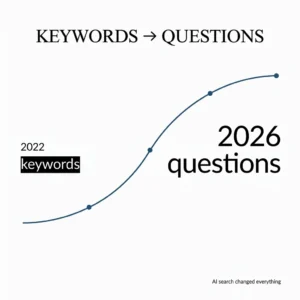
Here’s what changed: I’m not optimizing for just keywords anymore. I’m optimizing for questions. Real questions that real people ask when they’re trying to solve a problem your business fixes.
This isn’t speculation about the future. This is what I’m building right now, in 2026, because the way people find businesses has fundamentally shifted.
The Keyword Stuffing Conversation I Keep Having
I still sit across from business owners who think SEO works like it’s 2002.
They want me to jam “NYC plumber” into every paragraph. They think more keywords equal better rankings. They’re shocked when I tell them that approach will get their site penalized, not promoted.
Here’s how I explain it: If everyone keyword stuffed, there would be no Google.
Think about it. You’d search for “emergency plumber” and get pages that just repeat “emergency plumber emergency plumber emergency plumber” with no actual information. You’d stop using Google. Everyone would.
Google knows this. That’s why keyword stuffing is explicitly prohibited in their spam policies. A 2025 SEMrush study found that 62% of algorithmic penalties stem from content quality issues—and keyword stuffing tops that list.
The algorithm can detect when you’re writing for robots instead of humans.
And in 2026, it’s getting better at it every day.
What AI Search Actually Means for Your Service Business
Let me show you what’s happening right now with real numbers.
ChatGPT processes over 1 billion daily queries. AI Mode has 100 million monthly active users just in the U.S. and India. The average AI search query is 7.22 words long—compared to the traditional 2-3 word searches we optimized for.
People aren’t typing “plumber Queens” anymore.
They’re asking: “What should I do if my basement is flooding and it’s 11pm on a Sunday?”
That’s a completely different optimization challenge.
Here’s the part that matters for your business: 60% of searches now end without a click. People get their answer from an AI summary and never visit a website. When AI Overviews appear in search results, the top-ranking page sees a 58% lower click-through rate.
But here’s what I’m seeing in my client work—and this is important: AI-driven visits carry 4.4× more value than traditional organic traffic based on conversion rates.
The people who do click through after reading an AI summary are further along in their decision-making process. They’re ready to hire someone.
How I’m Rebuilding Sites for Conversational Search
The first thing I changed in how I build WordPress sites was the information architecture.
I had to convince clients to write for humans, not algorithms. That means answering questions. Having an FAQ section wherever possible. Structuring content around the actual problems people are trying to solve.
Here’s what that looks like in practice:
Old approach: A service page targeting “commercial HVAC repair” with that phrase repeated 15 times.
New approach: A comprehensive resource answering:
- How do I know if my commercial HVAC system needs repair or replacement?
- What’s the average cost to repair a commercial HVAC unit in New York?
- How long does commercial HVAC repair take?
- What happens if I ignore that weird noise my HVAC system is making?
The content reads like a conversation with an expert. Because that’s exactly what AI systems are looking for when they decide which sources to cite.
76% of AI Overview citations come from websites ranking in Google’s top 10 positions. But those positions aren’t going to sites with keyword density—they’re going to sites that demonstrate comprehensive understanding of a topic.
Entity-Based SEO Replaces Keyword Targeting
Here’s something most service businesses don’t realize yet: Google doesn’t think in keywords anymore. It thinks in entities.
An entity is a thing. A company. A service. A problem. A solution.
When I build a site now, I’m helping Google understand what entity your business represents and how it relates to other entities in your industry.
Let me give you a concrete example from a recent client project:
I built a content cluster for a commercial cleaning company. Not individual pages targeting “office cleaning,” “warehouse cleaning,” “retail cleaning”—but a comprehensive hub that establishes them as an authority on commercial cleaning in New York.
One pillar page explaining their approach. Supporting articles covering specific scenarios, challenges, and solutions. All interconnected. All demonstrating depth of knowledge.
The result: They now rank for hundreds of related queries they never optimized for individually.
That’s entity-based SEO. Google understands what they do, who they serve, and what problems they solve. It connects those dots automatically.
88% of SEO professionals now consider topical authority critical for ranking success. Building a content cluster—one pillar page plus 5-10 supporting articles—might cost $1,000 to $3,000 in content investment. But it yields faster ranking improvements than expensive backlink building.
Core Web Vitals Aren’t Optional Anymore
I need to talk about something technical that has real business impact: your site speed.
Core Web Vitals measure three things:
- How fast your largest content element loads (LCP)
- How quickly your site responds to interactions (INP)
- How much your page layout shifts while loading (CLS)
These are confirmed Google ranking factors. Pages ranking at position 1 are 10% more likely to pass Core Web Vitals thresholds compared to pages at position 9.
Here’s the problem: As of July 2025, only 44% of WordPress sites on mobile devices pass all three tests.
That means more than half of WordPress sites are giving visitors a poor experience—and getting penalized for it in search rankings.
When I build a WordPress site now, page speed isn’t a nice-to-have. It’s a requirement I build into the foundation. I’m choosing themes based on performance scores. I’m optimizing images before they’re uploaded. I’m minimizing plugins that slow down page load times.
When multiple sites offer similar content quality and authority, Core Web Vitals work as the tiebreaker. The site delivering superior user experience wins.
The FAQ Strategy That’s Working Right Now
I mentioned earlier that I’m adding FAQ sections wherever possible. Let me explain why this matters more in 2026 than it did before.
FAQ formats align perfectly with how users query AI systems. Phrases like “How do I…” and “What’s the difference between…” match the natural language people use when talking to ChatGPT or asking Google questions.
This structural match increases citation likelihood compared to keyword-optimized content.
Here’s my process for building effective FAQ sections:
01. I mine real customer questions
I ask clients to send me their support tickets, sales call recordings, and questions from their Google Business Profile. These are the actual questions their customers ask—not what we think they should be asking.
02. I structure answers conversationally
Each answer reads like you’re explaining it to someone sitting across from you. No jargon unless I immediately explain what it means. No corporate speak.
03. I add follow-up questions
People rarely have just one question. If someone asks “How much does commercial cleaning cost?”, they’re probably also wondering “How do you calculate square footage?” and “What’s included in that price?”
I answer all of them in the same section.
This approach captures emerging prompt patterns. When someone asks an AI system a question about your service, your FAQ section becomes the most cite-worthy source because it directly answers what they asked.
What I’m Doing Differently This Month
Let me get specific about what’s changed in my client work just in the past few months.
I’m building content for zero-click searches.
This sounds counterintuitive. If people aren’t clicking through, why optimize for those searches?
Because brand visibility matters even when people don’t click. When your business name appears in AI summaries as the source of helpful information, you’re building trust and recognition. When they’re ready to hire someone, they remember you.
I’m structuring content in layers.
Quick answer at the top for AI summaries. Detailed explanation in the middle for people who want to understand more. Related questions at the bottom for comprehensive coverage.
This serves both the AI systems extracting information and the humans who need deeper understanding.
I’m prioritizing mobile experience above everything else.
32% of internet users now use voice assistants weekly, mainly to search for information. Most of those searches happen on mobile devices. If your site doesn’t load fast and work perfectly on a phone, you’re invisible to a third of potential customers.
The Investment Reality
I need to be honest about what this approach requires.
Building comprehensive content clusters takes time and budget. Creating 25 authoritative articles within one tightly connected topic area might require $1,000 to $3,000 in content investment.
Optimizing Core Web Vitals might mean rebuilding parts of your site or switching to a better-performing theme.
This isn’t cheap. But here’s what I tell clients: 60% of marketing teams are reallocating part of their SEO budgets toward AI Search optimization by 2026. The businesses that invest now are the ones that will be visible when their competitors figure this out two years from now.
The alternative is continuing to optimize for a search environment that no longer exists.
What This Means for Service Businesses
If you run a service business—plumbing, HVAC, commercial cleaning, legal services, whatever—here’s what you need to understand:
The way people find you has changed. They’re not typing keywords into a search box and clicking the first blue link. They’re asking questions and expecting immediate, comprehensive answers.
Your website needs to be the source of those answers.
That means creating content that actually helps people solve problems. Answering the questions they’re really asking. Demonstrating expertise through depth of coverage, not keyword repetition.
I’m building WordPress sites in Queens that do exactly this. Sites that load fast, answer questions thoroughly, and establish clear topical authority in their service area.
The SEO strategies that worked in 2022 don’t work anymore. The strategies that will work in 2028 need to be implemented today.
That’s what I’m doing for my clients right now—preparing their online presence for a search environment where AI systems decide which businesses get visibility and which ones disappear.
If your site still relies on keyword stuffing and outdated SEO tactics, you’re already behind. The businesses winning in 2026 are the ones that started adapting in 2024.
I’m here to help you make that transition. Let’s build something that works for how people actually search today—and will keep working as search continues to change.