

I’ve been building WordPress websites for service businesses in New York for years. The rules just changed.
More than 1.5 billion people use Google AI Overview every month. ChatGPT has 800-900 million weekly active users. Your potential clients aren’t just typing queries into Google anymore—they’re asking AI engines for recommendations, comparisons, and solutions.
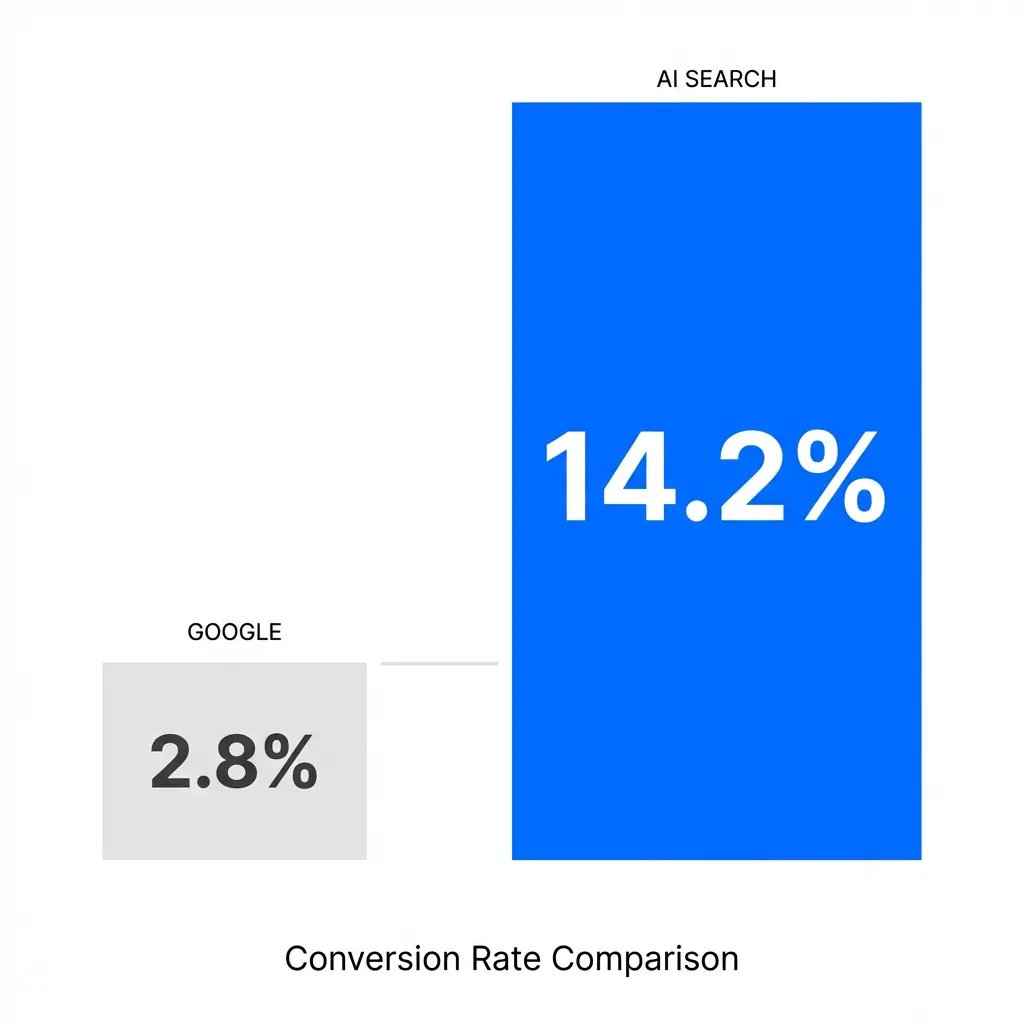
And here’s the part that matters for your business: AI search traffic converts at 14.2% compared to Google’s 2.8%.
That’s not a typo. Visitors arriving from AI platforms are 4.4 times more qualified than traditional search traffic. They spend 67.7% more time on your site. They’re not browsing—they’re ready to make decisions.
But there’s a problem.
Your WordPress Site Might Be Invisible to AI
I’m watching something happen across my client base. Businesses that rank well in Google aren’t showing up in AI responses. Their content exists, their SEO is solid, but when someone asks ChatGPT or Perplexity for a recommendation in their industry, they don’t get mentioned.
The visibility rules changed, and most agencies haven’t caught up yet.
Traditional SEO focused on keywords, backlinks, and rankings. Generative Engine Optimization (GEO) focuses on being the answer AI engines trust enough to cite.
Here’s what I mean: 99% of AI Overviews cite websites from Google’s organic top 10. Your SEO foundation still matters. But ranking isn’t enough anymore.
AI engines only cite 2-7 domains per response. Compare that to Google’s 10 blue links. The competition got narrower and more intense.
What I’m Seeing in Real Client Work
I rebuilt a client’s service pages last month. Same business, same offerings, same domain authority. The only changes were structural.
I moved the direct answer to the top 40 words. I added statistics every 150-200 words. I restructured headers to match how people actually ask questions. I implemented proper schema markup that AI engines could parse cleanly.
Within six weeks, they started appearing in ChatGPT responses for their core services.
That’s not luck. Pages with clear H2/H3/bullet point structures are 40% more likely to be cited by AI engines. Opening paragraphs that answer the query upfront get cited 67% more often.
Your WordPress site’s content architecture determines whether AI can understand, trust, and recommend you.
The Technical Foundation
I’m implementing these changes across my client sites:
Answer-first content structure. The first 40-60 words on every service page directly answer the core question someone would ask. No introduction, no context-setting, no company history. Just the answer.
Fact density. AI engines favor content that backs up claims with data. I’m adding statistics, case study results, and specific numbers every 150-200 words. Not fluff statistics—actual proof points that support the service value.
Source citations. I’m linking to authoritative sources throughout the content. Princeton research shows this improves AI visibility by 30-40%.
Schema markup. I’m implementing Organization, Service, FAQPage, and Review schema on every relevant page. AI engines use this structured data to understand what you offer and whether you’re credible.
Clear hierarchy. Questions as H2s. Direct answers as the first sentence under each H2. Supporting details in bulleted lists. This isn’t just good UX—it’s how AI engines parse and evaluate content.
Brand Authority Matters More Than Backlinks
Here’s something that surprised me: Brands in the top 25 percentile for web mentions averaged 169 AI Overview citations. The next group averaged only 14.
AI engines don’t just look at your website. They scan your entire digital footprint—review sites, industry forums, Reddit discussions, news mentions, social media, third-party articles.
This changes how I approach client visibility.
I’m helping service businesses build presence beyond their owned channels. Guest posts on industry blogs. Active participation in relevant forums. Getting featured in local business publications. Encouraging satisfied clients to leave detailed reviews on multiple platforms.
Your reputation across the web shapes how AI describes your brand. A strong backlink profile helps you rank. A strong mention profile helps AI trust you enough to recommend you.
What This Means for Service Businesses
I work with HVAC companies, law firms, accounting practices, construction contractors. Medium and large service businesses that depend on local and regional visibility.
These businesses face a specific challenge: 60% of searches now end without a click. AI provides the answer directly. Users don’t visit websites unless the AI response compels them to.
The click rate for position 1 with an AI Overview is only 2.6%. Think about that. You can rank first in Google, and if an AI Overview appears above you, almost nobody clicks through.
This fundamentally changes what “visibility” means.
I’m optimizing WordPress sites to be cited in AI responses, not just ranked in search results. The goal isn’t traffic volume—it’s being the business AI recommends when someone asks for help in your category.
The First-Mover Opportunity
Only 16% of brands systematically track AI search performance right now. Only 23% of marketers invest in GEO measurement tools.
I’m treating this as a first-mover advantage for my clients.
The agencies and businesses that adapt quickly will dominate AI citations in their categories. The ones that wait will spend years trying to catch up.
I’m implementing tracking systems that monitor when and how clients appear in AI responses. I’m testing different content structures to see what gets cited most often. I’m documenting what works so I can replicate it across similar businesses.
Companies that optimize for GEO see a 40% average increase in visibility across generative engines. That’s not incremental improvement—that’s a fundamental shift in how potential clients discover you.
What I’m Building Into Every WordPress Site
Every website I build or redesign now includes:
FAQ pages structured for AI parsing. Questions that match actual search queries. Answers that start with direct responses, then add supporting details. Proper FAQPage schema implementation.
Service pages optimized for citations. Clear descriptions of what you do, who you serve, and what results you deliver. Statistics that prove your expertise. Client testimonials with specific outcomes. Links to case studies and portfolio examples.
About pages that establish authority. Years in business. Team credentials. Industry certifications. Awards and recognition. Media mentions. Anything that signals credibility to AI engines scanning your site.
Blog content that answers specific questions. I’m moving away from general industry commentary toward detailed how-to guides, comparison articles, and problem-solving content. The kind of material AI engines pull from when answering user queries.
Technical infrastructure that AI can read. Fast load times. Clean code. Proper heading hierarchy. Descriptive alt text on images. Internal linking that shows topical relationships. XML sitemaps that help AI engines understand your site structure.
The Reality Check
This isn’t about abandoning SEO. 87% of ChatGPT citations correspond to Bing’s top search results. You need to rank well to have a chance at AI citations.
I’m building on the SEO foundation, not replacing it.
Your WordPress site still needs solid technical SEO. Fast hosting. Mobile optimization. Secure HTTPS. Clean URLs. Optimized images. All the fundamentals remain critical.
GEO adds a new layer: optimizing for how AI engines evaluate, understand, and cite your content.
What Service Businesses Should Do Now
Start with an audit. Look at your top service pages and ask:
Does the first paragraph directly answer the question someone would ask?
Are your claims backed up with specific statistics or proof points?
Do you cite authoritative sources throughout your content?
Is your content structured with clear headings and bulleted lists?
Have you implemented proper schema markup for your services?
Does your About page establish clear expertise and credibility?
Are you building brand mentions across third-party sites?
If you answered no to more than two of these questions, your WordPress site isn’t ready for AI search.
The Shift Is Happening Now
I’m watching search behavior change in real time. 77% of Americans use ChatGPT as a search engine, and 24% turn to it before Google.
Your potential clients are already asking AI for recommendations. The question is whether your business shows up in those responses.
I’m adapting every WordPress site I manage to meet this moment. The technical architecture, the content structure, the brand authority signals—all of it needs to work together to make your business visible to AI engines.
This isn’t theoretical. It’s not something to plan for next year. The businesses that position themselves now will own visibility in their categories as AI search continues to grow.
I’m here to help you make that transition. Your WordPress site can be optimized for both traditional search and AI citations. The foundation you’ve built isn’t wasted—it’s the starting point for the next phase of digital visibility.
If you’re ready to prepare your website for how people actually search today, let’s talk. I’ll audit your current site, identify the gaps, and build a plan to make you visible where your clients are looking